Imagine walking into a massive, unorganized library. Millions of books are piled on the floor without any labels, categories, or authors listed on the covers. If you were looking for a specific book on “Local Plumbing Services in Haryana,” how long would it take you to find it? Probably a lifetime.
Now, imagine walking into a modern library where every book has a digital barcode. Scan it, and you instantly know the author, the exact topic, the publication date, and the shelf number. You find what you need in seconds.
For search engines like Google, the internet is that massive library. And Schema Markup (Structured Data) is the digital barcode you put on your website to tell Google exactly what your business is, what you sell, and why you matter.
In 2026, simply having keywords on a page is no longer enough to dominate organic search. If you are a small business trying to outrank massive corporations, Advanced Schema Markup is your ultimate equalizer. It is the secret language that transforms boring search results into eye-catching Rich Snippets—driving massive Click-Through Rates (CTR) and outsmarting your competition.
In this comprehensive, expert-level guide, we are going to dive deep into what Schema Markup is, the exact JSON-LD codes small businesses need, how to avoid dangerous “schema spam” penalties, and how to audit your site to ensure you are eligible for Google’s Rich Results.

What Exactly is Schema Markup?
Schema Markup is a form of microdata. It is a standardized vocabulary created collaboratively by the world’s biggest search engines (Google, Bing, Yahoo, and Yandex) over at Schema.org.
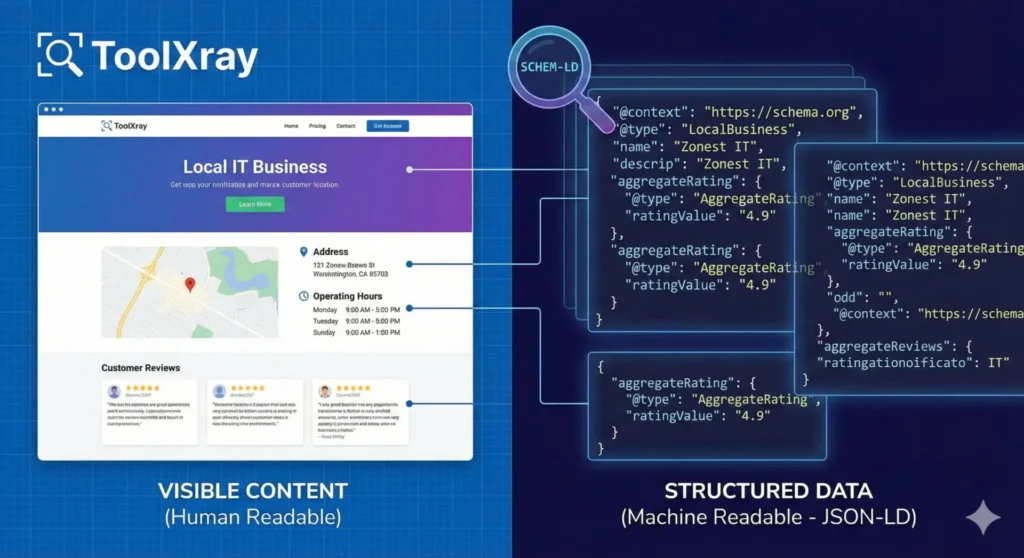
When you write a blog post or create a service page, humans can easily read the text and understand that “Zonest IT & Security Services” is a company, “Vikas Rohilla” is the founder, and “₹5000” is a price. But search engine bots are just algorithms. They read raw HTML. Without context, they might think “Zonest IT” is a software product, or “₹5000” is just a random number.
Schema Markup provides that missing context. It explicitly defines entities and their relationships. By injecting structured data into your website’s code, you are feeding Google a highly organized, spoon-fed summary of your business.
JSON-LD: The Modern Standard
Years ago, SEOs used messy formats like Microdata or RDFa, which required wrapping actual HTML elements in schema tags. It was a nightmare that ruined our Content-to-Code Ratio.
Today, Google strictly recommends JSON-LD (JavaScript Object Notation for Linked Data). JSON-LD is incredibly clean because it sits entirely separate from your HTML (usually in the <head> of your site). It doesn’t break your site’s design, it doesn’t cause HTML bloat, and bots can parse it in milliseconds.
Why Small Businesses MUST Use Schema in 2026
You might be thinking, “I already have good content and fast hosting. Why do I need to bother with JSON code?” Here is the brutal truth: Search Result Pages (SERPs) have changed.
1. The Power of Rich Snippets (The CTR Magnet)
Standard search results show a blue link and a two-line description. Boring.
A search result powered by Schema Markup can show gold review stars, product prices, in-stock availability, event dates, recipe cooking times, and dropdown FAQs. These are called Rich Snippets.
Studies show that a search result with a Rich Snippet can achieve a 30% to 50% higher Click-Through Rate (CTR) than a standard result sitting in the exact same position. Even if you are ranked #3, a rich snippet can steal the majority of clicks from the #1 spot.
2. Dominating Local SEO
If you run a local IT agency, a dental clinic, or a retail store, your biggest battle is Google Maps and the “Local Pack” (the top 3 local business results). Implementing advanced LocalBusiness schema explicitly feeds Google your geo-coordinates, operating hours, accepted payment methods, and specific service areas. It eliminates ambiguity and builds massive local trust.
3. Building E-E-A-T (Experience, Expertise, Authoritativeness, Trustworthiness)
Google wants to rank content written by real, verifiable experts. Using Person and Organization schema, you can digitally link your authors to their LinkedIn profiles, Wikipedia pages, and parent companies. This proves to Google that your business is a legitimate, authoritative entity in your niche.
🔍 Is Your Website Eligible for Rich Snippets?
Broken schema code is worse than no schema at all. A single missing comma in your JSON-LD can disqualify your entire website from earning Rich Results.
Don’t guess. Use the ToolXray Ultimate SEO Auditor. Our deep-scanning engine features an Advanced Schema Detector that instantly reveals every active schema type on your page, validates your JSON-LD, and tells you exactly if you are eligible for Google Rich Snippets.Run a Schema Markup Audit Now
Top 5 Schema Types Every Small Business Needs
There are hundreds of schema types available, but small businesses only need to focus on a critical few to see a massive ROI. Here are the top 5, complete with insights on how they work.
1. LocalBusiness Schema
This is non-negotiable for brick-and-mortar stores or local service providers. It tells Google your exact NAP (Name, Address, Phone Number). You can get incredibly granular with this.
Example of what the JSON-LD looks like:
<script type="application/ld+json">
{
  "@context": "https://schema.org",
  "@type": "ProfessionalService",
  "name": "Zonest IT & Security Services",
  "image": "https://toolxray.com/logo.png",
  "@id": "",
  "url": "https://toolxray.com",
  "telephone": "+91-XXXXXXXXXX",
  "address": {
    "@type": "PostalAddress",
    "streetAddress": "Main Office",
    "addressLocality": "Jhajjar",
    "addressRegion": "Haryana",
    "addressCountry": "IN"
  },
  "openingHoursSpecification": {
    "@type": "OpeningHoursSpecification",
    "dayOfWeek": ["Monday", "Tuesday", "Wednesday", "Thursday", "Friday"],
    "opens": "09:00",
    "closes": "18:00"
  }
}
</script>
2. FAQPage Schema
This is the ultimate SERP real estate hack. By marking up your Frequently Asked Questions with FAQPage schema, Google may display those questions and answers directly underneath your search listing.
Not only does this provide instant value to the searcher, but it physically pushes your competitors further down the screen, especially on mobile devices!
3. Product and AggregateRating Schema
If you run an e-commerce store (like WooCommerce or Shopify), this is how you get those beautiful gold stars to appear next to your products in Google. You can markup the product price, the currency, the availability (InStock), and the aggregate rating based on customer reviews. Searchers are exponentially more likely to click a result with 5 gold stars than a standard text link.
4. Article / BlogPosting Schema
If you are investing in content marketing to drive traffic, your blogs need BlogPosting or Article schema. This structured data specifies the headline, the featured image, the date published, the date modified, and the author. This is highly recommended by Google for inclusion in the “Top Stories” carousel on mobile devices.
5. Organization Schema
Usually placed on your homepage or “About Us” page, Organization schema establishes your brand. It allows you to define your official logo, your social media profiles (Facebook, Twitter, LinkedIn), and your corporate contact data. This is what helps trigger those large, professional “Knowledge Panels” on the right side of Google desktop searches when someone searches for your brand name.

How to Implement Schema on Your WordPress Site
Implementing JSON-LD is easier than it looks. You have two primary options:
Option A: The Plugin Route (Easiest)
If you are using a top-tier SEO plugin like Rank Math, Yoast, or All in One SEO, basic schema implementation is usually built-in. You can set up global rules (e.g., all blogs get Article schema) and use their wizards to fill in your LocalBusiness data. (Curious what plugins your competitors use for their schema? Check out our WordPress Tech Stack Detector to find out).
Option B: Custom Header Injection (Most Precise)
Plugins can sometimes add bloated or conflicting schema. If you want absolute precision, you can generate your own JSON-LD code using free online generators, and inject it directly into the <head> of specific pages using a simple plugin like “Insert Headers and Footers” or via your child theme’s functions.php file.
The Danger of Schema Spam (What NOT to Do)
With great power comes great responsibility. Because Schema Markup can drastically increase your CTR, some black-hat SEOs try to manipulate it. Google strictly penalizes “Schema Spam.”
Here are the deadly sins of structured data:
- Marking up hidden content: If you put FAQ schema in your JSON-LD, those exact questions and answers MUST be visible to the user on the actual webpage. You cannot hide text from users but show it to Google.
- Fake Reviews: Never hard-code 5-star
AggregateRatingschema if you do not actually have a mechanism on your site that collects real user reviews. Google will hit you with a manual penalty. - Irrelevant Types: Do not use
Recipeschema for an IT services page just to get a picture in the search results. Keep your types strictly relevant to your actual content.
Beyond Schema: The Technical SEO Ecosystem
Advanced Schema Markup is incredibly powerful, but it is not a magic wand. It is just one piece of the technical SEO puzzle.
If you have perfect JSON-LD, but your server takes 3 seconds to respond, Googlebot won’t stick around long enough to read your schema. Ensure you have optimized your Time to First Byte (TTFB).
Similarly, if your JSON-LD is buried under massive amounts of bloated CSS and JavaScript from a heavy page builder, your Content-to-Code Ratio will suffer, confusing search engines.
Need Professional Technical SEO Implementation?
Writing and validating custom JSON-LD for enterprise businesses, e-commerce stores, and complex service agencies requires a deep understanding of code architecture and Google’s webmaster guidelines.
At ToolXray, our tools give you the diagnostics, but our parent agency, Zonest IT & Security Services, provides the cure. We specialize in:
- Custom JSON-LD Schema implementation for Local SEO and E-Commerce.
- Enterprise-grade technical SEO audits and code refactoring.
- Building high-performance, secure WordPress architectures.
If your business is struggling to stand out in the search results, don’t let your competitors steal your clicks with Rich Snippets. Start by auditing your website with the ToolXray SEO Analyzer, and if you need expert deployment, our IT team is ready to scale your digital presence.